Please visit our new homepage
The live version of this site is now published at costar-foresight-lab.github.io/ai-casebook/. Please update your bookmarks as this demo version of the AI Casebook is no longer maintained or updated.Background
SuperScout is a London-based software company building a location platform for the film and screen industry. Founded by Gabriel Isserlis, the company was born from the idea of creating a platform to allow screen professionals to manage their image assets and locations data outside of Dropbox folders or spreadsheets.
The platform looks and feels like Airbnb, says Isserlis, with locations on the left of the user interface and maps on the right. It is a fully private database for each subscriber of the platform but with the ability to share with clients or agencies. After initially targeting individual location scouts, the company has found traction with film offices. SuperScout now has customers across the UK, USA and Europe, with English Heritage among its clients (see screenshot below). The platform is web-based and has an iOS app; it allows users to upload photos, location data and metadata for each location. This can be done in an offline mode whilst travelling, and then as a bulk upload when back on wifi or mobile data.
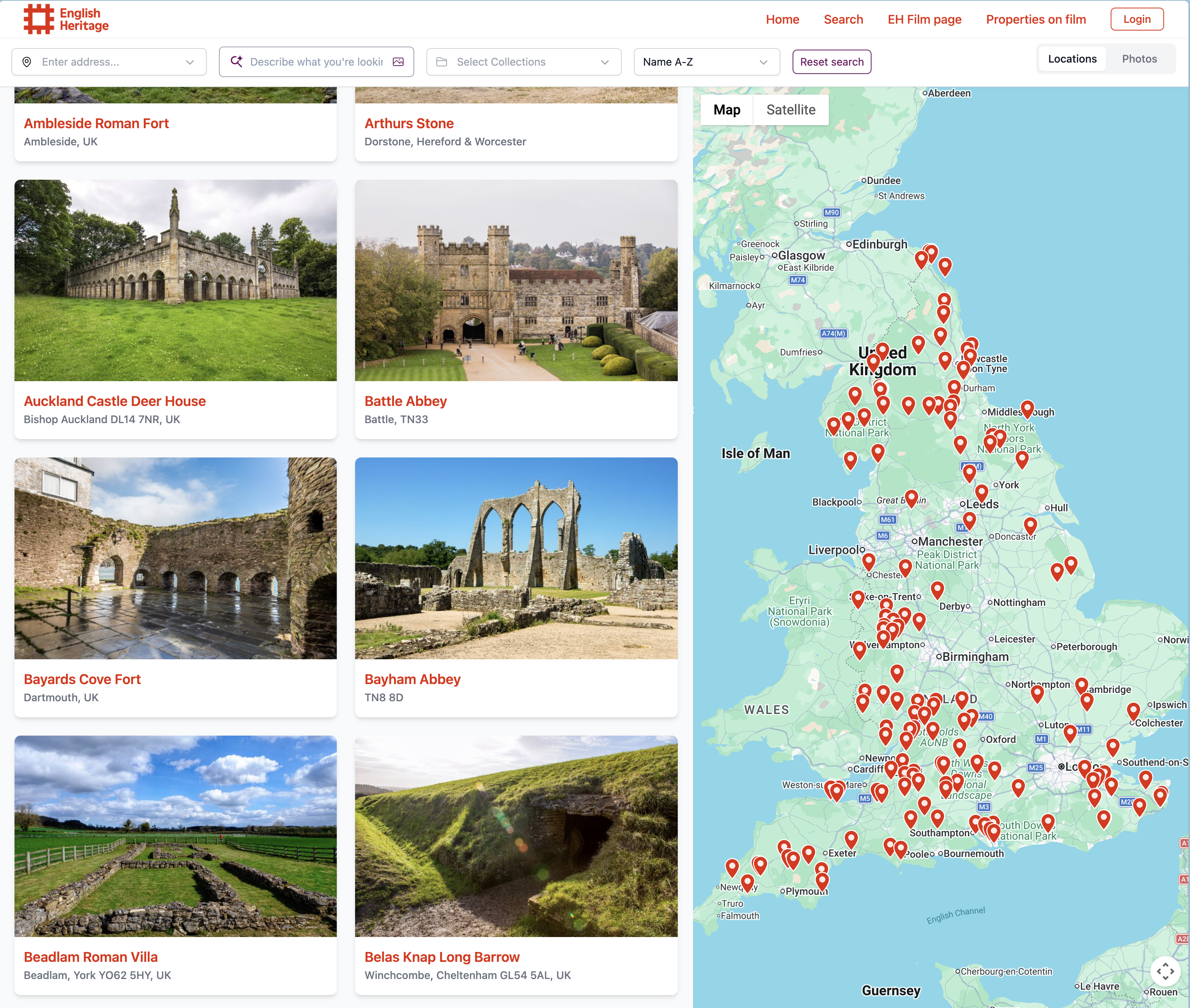
A screenshot of the English Heritage public database of locations (work in progress), built on the ScreenScout platform. Image courtesy of ScreenScout.
Application of AI
Every photo uploaded to SuperScout is automatically tagged with keywords generated by an image recognition model. For users this is invisible: if they upload a picture of a kitchen, for example, the photo will be tagged with “kitchen”, “counter”, “utensils”, “sink”, etc. There is no manual tagging step, however tags can be edited in retrospect.
For organisations managing large databases of locations and images, the impact can be substantial: one film office reported to SuperScout that uploading a single location could take up to 40 minutes with previous workflows, whereas the automated tagging process reduces this to less than 5 minutes.
The SuperScout team initially used the OpenAI API to access vision-enabled models, but through testing identified challenges with certain models, including cultural bias. This included the misidentification of non-Western architecture as variations on Western architecture – an Indian palace labelled as an “orange medieval castle”, for example. So the team moved to an open weights model via the HuggingFace platform. The workflow itself, which simultaneously extracts keywords, generates search embeddings and produces other structured metadata for the platform, took weeks of testing to refine.
Applying the CoSTAR Foresight Lab AI roadmap
Our AI roadmap is organised around three strategic outcomes – frameworks, targeted support, and growth – and driven by nine recommendations that seek to align technological advancement with ethical responsibility and economic opportunity, ensuring long-term growth and success of the UK screen sector.
How this case study aligns with the roadmap
- Responsible AI
- SuperScout’s decision to test and reject models that produced culturally biased outputs, choosing accuracy over convenience, is a practical example of responsible model selection.
- Investment
- The company has been supported by investment through the MyWorld programme, which funded development of the iOS app to bring the SuperScout workflow into the field. The company has had a variety of funding sources and is currently exploring longer-term funding.
- Sector adaptation
- SuperScout addresses a long-standing infrastructure gap. The reliance on Dropbox and photography portfolio sites across productions at every budget level represents exactly the friction that well-targeted technology can remove. Traction with film offices and heritage organisations points toward a potential role as shared infrastructure for location data in the UK screen sector, created by a UK team.
Resources
- SuperScout
- Global Locations, a public-facing site listing filming locations, built on the SuperScout platform.
Citation
@online{johnston2026,
  author = {Johnston, David},
  publisher = {CoSTAR Foresight Lab},
  title = {SuperScout: {Automating} Location Intelligence for the Film
    and Screen Industry},
  date = {2026-03-19},
  langid = {en}
}